Stainless Steel vs. Ceramic Cookware: Which Is Better for Your Kitchen?
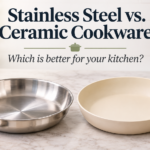
If you’re shopping for a new pan, stainless steel and ceramic-coated cookware can both look appealing, but they behave differently on the stove. Understanding their differences can help you choose what fits your cooking style.
In this comparison, ceramic cookware refers to ceramic-coated metal pans, not cookware made entirely from ceramic.
Baking Pan Conversion Chart: Easy Substitutions for Common Pan Sizes
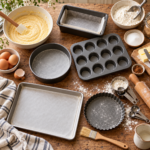
Ever start a recipe only to discover that you don’t have the baking pan it calls for? Before changing your plans or buying another pan, check the Baking Pan Conversion Chart below ↓ to find out whether a pan you already have in your kitchen might work.
And if you’d rather skip the math, try our FREE Pan Swaps Calculator →
Don’t Have the Right Baking Pan? Try Our Free Pan Swaps Calculator
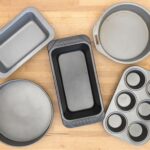
Ever start baking and discover your recipe calls for a pan you don’t have? Maybe you need an 8-inch square pan, but all you have is a 9-inch round.
Before changing your recipe or buying another pan, try our FREE Pan Swaps Calculator!
Cutting Board Sliding on Your Counter? 4 Simple Fixes Before You Replace It
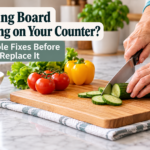
Ever tried chopping an onion or slicing vegetables, only to have your cutting board slide across the counter?
It’s annoying, but it’s also a safety concern. A board that moves unexpectedly can make it harder to control your knife.
The good news? You may not need a new cutting board. Before replacing yours, try these four simple fixes.
18/10 vs. 18/8 vs. 18/0 Stainless Steel Cookware: What Do the Numbers Mean?
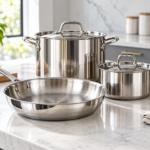
If you have ever looked at the bottom of a stainless steel pan and wondered what numbers like 18/10, 18/8, or 18/0 mean, you are not alone.
They are not sizes or quality scores. The numbers refer to the approximate amounts of chromium and nickel used in the stainless steel.
Those ingredients affect characteristics such as corrosion resistance, appearance, and magnetism. But the numbers are only part of the story when choosing cookware.
How to Care for Cutting Boards: Wood, Plastic, Stainless Steel & Titanium
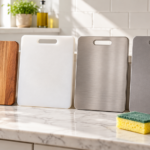
A cutting board may seem like one of the simplest tools in your kitchen, but different materials need different kinds of care.
The cleaning routine that works perfectly well for a plastic board may shorten the life of a wooden one. Stainless steel and titanium are generally easy-care surfaces, but they still benefit from proper washing and drying.
The good news? None of this has to be complicated.
Here’s how to care for some of the most common cutting board materials—and a few things you’ll want to avoid.
Lightweight Cookware for Older Adults: What to Look for When Heavy Pans Are Hard to Handle
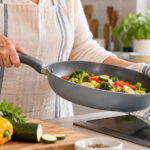
A beautiful pan isn’t very useful if you dread picking it up.
As we get older, cookware weight can start to matter more than it once did. A large skillet that felt perfectly manageable years ago may become awkward when it is filled with food. Heavy lids, thick handles, and oversized stockpots can also make everyday cooking more work than it needs to be.
That doesn’t mean you have to give up good cookware.
The goal is simply to choose pots and pans that are comfortable to lift, easy to control, and practical for the way you cook now.
Here are some of the most important things to consider when shopping for lightweight cookware.
Are Titanium Cutting Boards Bad for Knives? What Home Cooks Should Know
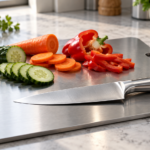
Titanium cutting boards are getting attention from home cooks who want a durable, easy-to-clean alternative to wood and plastic. But before switching to a metal cutting surface, there’s an important question to ask:
Are titanium cutting boards bad for knives?
The short answer is: they can cause a knife edge to wear faster than a softer cutting surface such as wood or some plastics. That doesn’t mean a titanium cutting board will immediately ruin your knives. How quickly a blade dulls depends on the board’s construction, your knife, how often you cook, and the way you cut.
Here’s what home cooks should know before deciding whether titanium belongs in the kitchen.
Best Induction Cookware for Even Heat (2026)
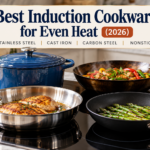
The best induction cookware starts with a flat, magnetic base that matches the size of your cooktop’s cooking zone. Construction matters too: a well-made pan with a substantial base can help spread heat more evenly and respond predictably to changes in power.
There is no single cookware material that is best for every job. Fully clad stainless steel is a strong all-purpose choice, enameled cast iron excels at heat retention, carbon steel works well for high-heat cooking, and induction-compatible nonstick can be useful for delicate foods.
Before You Buy That Stainless Steel Pan: What 18/10, 18/8 and 18/0 Really Mean
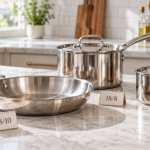
You’re comparing two shiny stainless-steel pans.
One says 18/10 stainless steel.
Another says 18/8.
Then you find a third marked 18/0.
So naturally, 18/10 must be the best one, right?
Not necessarily.
And here’s the first surprise: those numbers do not tell you how thick, heavy or heavy-duty the pan is.
They describe the approximate makeup of the stainless-steel alloy—specifically its chromium and nickel content. British Stainless Steel Association
Once you understand that, stainless-steel labels start making a lot more sense.