CookwareTalk Guides
Grill, Portable Stove, or Camp Cooker? Choosing an Outdoor Cooking Setup

Affiliate disclosure: CookwareTalk may earn a commission if you purchase through some links in this article, at no additional cost to you. Affiliate relationships do not determine our editorial conclusions.
You can cook outdoors with a $40 single-burner stove, a two-burner camp kitchen, a high-heat grill, a pizza oven, or a compact backpacking cook system.
That is the good news.
The bad news is that shopping gets confusing fast if you start with products instead of meals.
So before you ask, “Which cooker should I buy?” ask a better question:
What do I actually want to cook, for how many people, and how far do I have to carry the equipment?
Choose a portable camp stove if you want familiar pan cooking outdoors
A portable propane or butane stove is the closest thing to moving part of your kitchen range outside. Put a pot or skillet on top and you can boil, simmer, sauté, or make breakfast without building a fire.
This is a strong fit for:
- car camping;
- picnics and tailgates where fuel stoves are permitted;
- breakfasts with eggs, pancakes, or a skillet meal;
- people who already own cookware they like using outdoors;
- cooks who want adjustable heat instead of managing charcoal or wood.
A two-burner model gives you more flexibility for group meals. A one-burner model saves space and works well for simpler cooking.
Choose a grill if the flame-and-sear experience is the point
If your outdoor menu starts with burgers, steaks, kebabs, grilled vegetables, or food you specifically want exposed to grill-style heat, a portable grill may make more sense than a small stove.
Grills generally trade some portability and fine saucepan control for a larger direct-cooking surface and a more familiar barbecue experience.
That can be perfect for the backyard or car camping. It is less appealing if you have to carry every ounce on foot.
Choose a compact cook system if packability matters most
Backpacking-style stoves and integrated cook systems prioritize compact storage, lower weight, and fast heating of water or simple meals. Fire Maple, for example, currently sells ultralight canister stoves, one-liter integrated systems, larger basecamp stoves, and flat-pack wood stoves.
This type of setup can make more sense when your goal is coffee, oatmeal, soup, noodles, dehydrated meals, or one-pot cooking rather than a campsite brunch for six.
What about outdoor pizza ovens and specialty cookers?
Specialty equipment earns its space when the cooking style itself is the attraction.
A pizza oven is not the most efficient choice for boiling water. A backpacking burner is not the most comfortable choice for cooking six pancakes at once. A high-heat grill is overkill if your entire plan is morning coffee.
The right question is not “Which cooker is the most impressive?”
It is “Which one makes the food I actually plan to cook easier?”
Fast decision guide
| If you care most about… | Start with… |
|---|---|
| Breakfast, skillets, pots, and two dishes at once | Two-burner portable camp stove |
| Compact one-pan meals or boiling water at a picnic | Single-burner stove |
| Backpacking weight and packability | Compact canister stove or integrated cook system |
| Burgers, steaks, kebabs, grill marks | Portable grill |
| Pizza nights as the main event | Portable pizza oven |
| Backyard entertaining with lots of cooking space | Larger outdoor grill or cooking station |
Fuel matters as much as the cooker
Before buying, check what fuel the unit requires, how easily you can buy that fuel where you travel, and what the campground or public land allows.
Propane, butane, isobutane canisters, pellets, charcoal, and wood all create different packing, storage, ignition, and restriction considerations.
Do not assume that because a cooker is portable it is permitted everywhere.
Outdoor cooking safety is not optional
The National Park Service recommends checking conditions and restrictions, keeping portable stoves clear of grasses and other vegetation that could ignite, preventing stoves from tipping, and never leaving fire unattended.
Fuel-burning camping stoves and grills should be used in appropriate outdoor areas according to the manufacturer’s instructions. Do not operate a propane or other fuel-burning camp stove inside a tent, vehicle, garage, or other enclosed space.
Practice with a new stove before the trip. NPS specifically recommends trying a new camp stove ahead of time so you are not learning ignition, assembly, or fuel connection while hungry at the campsite.
CookwareTalk Partner Option: Big Horn Outdoors
If you are a car camper, tailgater, backyard cook, or group-meal person, Big Horn Outdoors currently offers portable propane and butane camping stoves as well as grills and outdoor pizza ovens.
CookwareTalk Partner Option: Fire Maple
If you care more about compact camping stoves, backpacking cook systems, or lightweight outdoor cookware, Fire Maple offers a broad range of canister stoves and integrated systems.
Explore Fire Maple Camping Gear
Partner note: Product availability, specifications, prices, fuel requirements, and fire restrictions can change. Confirm the manufacturer’s current instructions and the rules for your destination before buying or using outdoor cooking equipment.
CookwareTalk bottom line
Buy for the meal and the trip—not for the gear photo.
If you are driving to a campsite and feeding four people, a two-burner stove may make you happier than an ultralight burner. If you are carrying everything on your back, the opposite may be true.
Start with meal style, group size, carry distance, fuel, and local rules. Once those five things are clear, the equipment list gets much shorter.
Sources & Learn More
Kitchen Germs: What Actually Needs Cleaning—and What Are We Overthinking?
CookwareTalk note: This article is general food-safety information, not medical advice. People at higher risk for serious foodborne illness should follow guidance from their healthcare professional and public-health authorities.
Some kitchen habits deserve our attention.
Others mostly deserve to stop living rent-free in our heads.
You do not need to turn dinner cleanup into a surgical scrub. You do need to pay attention to the places where raw-food juices, dirty hands, utensils, and ready-to-eat foods can cross paths.
The simplest framework comes from CDC: Clean. Separate. Cook. Chill.
What actually deserves your cleaning energy?
1. Your hands
Wash your hands before food prep and after handling raw meat, poultry, seafood, eggs, or other messy ingredients. CDC recommends washing for at least 20 seconds with soap and water.
This sounds basic because it is basic—and basic is powerful.
2. Cutting boards and knives after risky foods
If a board just held raw chicken, it should not become the tomato board without a wash in between. USDA recommends hot, soapy water after each use and specifically advises using separate boards for raw meat, poultry, and seafood and ready-to-eat foods when possible.
That separation is not about owning a rainbow-colored set of seven boards. It is about keeping raw juices away from foods that will not get cooked later.
3. Countertops and handles you touched with messy hands
If you opened a package of raw meat, touched a faucet handle, grabbed a spice jar, then went back to cooking, those touch points are worth remembering. Cross-contamination often happens through the route your hands take around the kitchen.
Clean food-contact surfaces and obvious touch points with warm or hot soapy water as appropriate for the surface.
4. The sink after raw-food cleanup
The sink is not a magical germ disposal portal. USDA notes that washing raw meat or poultry can spread bacteria through splashing, including around the sink and nearby surfaces.
If raw juices have been in the sink, clean the sink and surrounding area rather than assuming running water took care of everything.
What should you NOT wash?
Please stop washing raw chicken
USDA does not recommend washing raw poultry before cooking. Splashing water can spread bacteria to food, utensils, countertops, and the sink. Rinsing does not destroy the bacteria; proper cooking does.
Chicken should reach a safe internal temperature of 165°F, measured with a food thermometer.
So the safer routine is: package to prep, prep to heat, then wash the surfaces and tools that touched it.
Cleaning and sanitizing are not the same thing
USDA makes a useful distinction:
- Cleaning removes food, grease, dirt, and some germs.
- Sanitizing is an additional step designed to reduce or kill more germs on a cleaned surface.
And the order matters: clean first, then sanitize when sanitizing is appropriate.
For an ordinary home meal, routine washing with soap and water does a lot of the heavy lifting. After raw meat, poultry, seafood, illness in the household, or another higher-risk mess, you may choose an appropriate food-contact sanitizer following its label directions and the material maker’s care instructions.
Never mix cleaning chemicals. More chemical is not automatically more clean.
What are we probably overthinking?
“I need to disinfect the entire kitchen after making a sandwich.”
Probably not. Focus your effort where contamination actually occurred.
“A nonporous cutting board means I can stop worrying about cross-contamination.”
No. Nonporous surfaces can be straightforward to clean, but they still need to be washed after use. Material choice does not replace good handling.
“Wood is automatically unsafe for raw meat.”
USDA says consumers may use wood or nonporous boards for raw meat and poultry. The critical steps are proper cleaning and preventing raw-food juices from reaching ready-to-eat foods.
“If I cannot smell anything, it must be clean.”
Smell is not a food-safety test. A surface can look and smell normal and still need cleaning because of what touched it.
A calmer kitchen routine
Try this instead of mentally scanning every inch of the room for invisible enemies:
- Start with clean hands and a reasonably clean work area.
- Keep raw animal foods separate from ready-to-eat foods.
- Wash the tools and surfaces that actually touched raw food.
- Use a food thermometer instead of guessing doneness.
- Refrigerate perishables promptly.
- Replace cutting boards that develop deep, hard-to-clean grooves.
That is a lot more useful than panic-cleaning the spice cabinet because chicken existed somewhere in the room.
CookwareTalk bottom line
A safe kitchen does not have to be a sterile kitchen.
Pay attention to hands, raw-food juices, food-contact surfaces, separation, safe cooking temperatures, and refrigeration. Those are the habits public-health guidance keeps returning to for a reason.
Clean what got dirty. Separate what can cross-contaminate. Cook what needs cooking. Chill what needs chilling.
Then enjoy your dinner.
Keep reading on CookwareTalk
If cutting-board material is part of what you are deciding, compare the tradeoffs in Wood vs. Stainless Steel vs. Titanium Cutting Boards: Which Fits Your Kitchen?
Sources & Learn More
Wood vs. Stainless Steel vs. Titanium Cutting Boards: Which Fits Your Kitchen?
Affiliate disclosure: CookwareTalk may earn a commission if you purchase through some links in this article, at no additional cost to you. Recommendations and tradeoffs are based on product fit and available evidence, not on which offer pays a commission.
Three cutting boards can all be washable, durable, and useful—and still feel completely different in your kitchen.
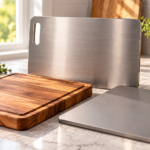
Wood gives you a softer, classic cutting surface. Stainless steel gives you a hard, nonporous work surface with very little routine care. Titanium aims for a similar low-maintenance metal experience with less weight than many steel boards.
So which one is “best”?
That depends on what you care about enough to notice every single day.
Quick comparison
| Priority | Wood | Stainless steel | Titanium |
|---|---|---|---|
| Knife friendliness | Strongest of these three | Hard surface; expect faster edge wear | Hard metal surface; less forgiving than wood |
| Routine upkeep | Needs drying and, for many boards, periodic oiling | Low | Low; follow the maker’s care instructions |
| Nonporous surface | No | Yes | Yes |
| Weight/handling | Varies widely | Can feel substantial or heavy | Can be lighter than steel, depending on size and construction |
| Classic counter look | Strong | Industrial/modern | Modern/minimal |
Wood: the knife-friendly traditionalist
If protecting your knife edge is your biggest concern, wood has a strong case.
Knife-care guidance from WÜSTHOF specifically recommends avoiding hard cutting surfaces such as metal, glass, and very hard boards because they can dull an edge faster. Wood or other blade-friendly surfaces are the safer everyday choice when edge retention is a priority.
Wood also has a warmer look and a little more give under the knife. That feel is one reason many cooks simply enjoy chopping on it.
The tradeoff is care. Wood should not be left sitting wet. Many wooden boards benefit from periodic food-safe mineral oil or whatever maintenance the manufacturer recommends. A good board can last a long time, but it asks you to participate in that relationship.
But can wood be used for raw meat?
Yes. USDA says consumers may use either wood or a nonporous board for raw meat and poultry. The bigger food-safety issue is cross-contamination: use a separate board for raw meat, poultry, and seafood when possible, or thoroughly wash the board with hot, soapy water before it touches ready-to-eat foods.
Stainless steel: sturdy, low-upkeep, and hard on edges
Stainless steel is attractive to cooks who want a nonporous surface that does not need oiling or conditioning. It can be wiped and washed without the moisture concerns that come with wood.
But the same hard, unyielding surface that makes steel easy to maintain is not gentle on a knife edge. If you use expensive thin-bladed knives and hate sharpening, stainless is probably not your everyday chopping-board soulmate.
For some households, a metal board still makes sense as a dedicated prep surface—especially when low upkeep matters more than maximum edge retention. Just go into the choice understanding the tradeoff.
Titanium: low upkeep and lighter handling—with a knife tradeoff
Titanium cutting boards have become popular because the material is nonporous, corrosion-resistant, and can be relatively light for a metal board depending on the board’s size and construction. They do not require wood-style oiling.
The important part CookwareTalk will not skip: titanium is still a metal cutting surface. Independent testing and knife-care guidance have raised concerns about faster edge wear compared with wood or softer boards, so knife feel and edge maintenance are worth considering before choosing any metal cutting board.
That does not make titanium useless. It means the reason to choose it should be something you genuinely value—such as low upkeep, nonporous construction, or lighter handling—not a belief that it has no tradeoffs.
Which material fits which cook?
Choose wood if:
- protecting your knife edge is near the top of your list;
- you like a warmer, traditional cutting surface;
- you are willing to dry and maintain the board properly.
Consider stainless steel if:
- you want a sturdy metal prep surface;
- very low routine upkeep matters more than knife-edge preservation;
- you are comfortable honing or sharpening more often.
Consider titanium if:
- you want a low-maintenance metal board;
- lighter handling matters to you;
- you understand that a rigid metal surface can be less forgiving on knives than wood.
Food safety: material is only part of the story
No cutting-board material replaces basic kitchen habits. CDC’s core food-safety steps are Clean, Separate, Cook, and Chill. USDA recommends washing cutting boards with hot, soapy water after each use and replacing boards that become excessively worn or develop hard-to-clean grooves.
If you prepare raw meat, poultry, or seafood, separating that work from foods such as salad ingredients matters more than chasing a “germ-proof” material label.
CookwareTalk Partner Option: Titan Haus Titanium Cutting Board
If your quiz or your own priorities point toward titanium, Titan Haus is a current CookwareTalk affiliate option to compare.
See Titan Haus Titanium Cutting Board
Affiliate disclosure: CookwareTalk may earn a commission if you purchase through this link, at no additional cost to you. The affiliate relationship does not determine our quiz scoring or editorial conclusions.
Not sure which one sounds like you?
Take the CookwareTalk 5-question Cutting Board Match Quiz. It compares your cleanup preferences, knife priorities, upkeep tolerance, durability concerns, and handling preference before giving you a result.
Keep reading on CookwareTalk
Wondering how much the board material itself matters for food safety? Read Kitchen Germs: What Actually Needs Cleaning—and What Are We Overthinking?