Kitchen Tools
Wood vs. Stainless Steel vs. Titanium Cutting Boards: Which Fits Your Kitchen?
Affiliate disclosure: CookwareTalk may earn a commission if you purchase through some links in this article, at no additional cost to you. Recommendations and tradeoffs are based on product fit and available evidence, not on which offer pays a commission.
Three cutting boards can all be washable, durable, and useful—and still feel completely different in your kitchen.
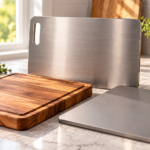
Wood gives you a softer, classic cutting surface. Stainless steel gives you a hard, nonporous work surface with very little routine care. Titanium aims for a similar low-maintenance metal experience with less weight than many steel boards.
So which one is “best”?
That depends on what you care about enough to notice every single day.
Quick comparison
| Priority | Wood | Stainless steel | Titanium |
|---|---|---|---|
| Knife friendliness | Strongest of these three | Hard surface; expect faster edge wear | Hard metal surface; less forgiving than wood |
| Routine upkeep | Needs drying and, for many boards, periodic oiling | Low | Low; follow the maker’s care instructions |
| Nonporous surface | No | Yes | Yes |
| Weight/handling | Varies widely | Can feel substantial or heavy | Can be lighter than steel, depending on size and construction |
| Classic counter look | Strong | Industrial/modern | Modern/minimal |
Wood: the knife-friendly traditionalist
If protecting your knife edge is your biggest concern, wood has a strong case.
Knife-care guidance from WÜSTHOF specifically recommends avoiding hard cutting surfaces such as metal, glass, and very hard boards because they can dull an edge faster. Wood or other blade-friendly surfaces are the safer everyday choice when edge retention is a priority.
Wood also has a warmer look and a little more give under the knife. That feel is one reason many cooks simply enjoy chopping on it.
The tradeoff is care. Wood should not be left sitting wet. Many wooden boards benefit from periodic food-safe mineral oil or whatever maintenance the manufacturer recommends. A good board can last a long time, but it asks you to participate in that relationship.
But can wood be used for raw meat?
Yes. USDA says consumers may use either wood or a nonporous board for raw meat and poultry. The bigger food-safety issue is cross-contamination: use a separate board for raw meat, poultry, and seafood when possible, or thoroughly wash the board with hot, soapy water before it touches ready-to-eat foods.
Stainless steel: sturdy, low-upkeep, and hard on edges
Stainless steel is attractive to cooks who want a nonporous surface that does not need oiling or conditioning. It can be wiped and washed without the moisture concerns that come with wood.
But the same hard, unyielding surface that makes steel easy to maintain is not gentle on a knife edge. If you use expensive thin-bladed knives and hate sharpening, stainless is probably not your everyday chopping-board soulmate.
For some households, a metal board still makes sense as a dedicated prep surface—especially when low upkeep matters more than maximum edge retention. Just go into the choice understanding the tradeoff.
Titanium: low upkeep and lighter handling—with a knife tradeoff
Titanium cutting boards have become popular because the material is nonporous, corrosion-resistant, and can be relatively light for a metal board depending on the board’s size and construction. They do not require wood-style oiling.
The important part CookwareTalk will not skip: titanium is still a metal cutting surface. Independent testing and knife-care guidance have raised concerns about faster edge wear compared with wood or softer boards, so knife feel and edge maintenance are worth considering before choosing any metal cutting board.
That does not make titanium useless. It means the reason to choose it should be something you genuinely value—such as low upkeep, nonporous construction, or lighter handling—not a belief that it has no tradeoffs.
Which material fits which cook?
Choose wood if:
- protecting your knife edge is near the top of your list;
- you like a warmer, traditional cutting surface;
- you are willing to dry and maintain the board properly.
Consider stainless steel if:
- you want a sturdy metal prep surface;
- very low routine upkeep matters more than knife-edge preservation;
- you are comfortable honing or sharpening more often.
Consider titanium if:
- you want a low-maintenance metal board;
- lighter handling matters to you;
- you understand that a rigid metal surface can be less forgiving on knives than wood.
Food safety: material is only part of the story
No cutting-board material replaces basic kitchen habits. CDC’s core food-safety steps are Clean, Separate, Cook, and Chill. USDA recommends washing cutting boards with hot, soapy water after each use and replacing boards that become excessively worn or develop hard-to-clean grooves.
If you prepare raw meat, poultry, or seafood, separating that work from foods such as salad ingredients matters more than chasing a “germ-proof” material label.
CookwareTalk Partner Option: Titan Haus Titanium Cutting Board
If your quiz or your own priorities point toward titanium, Titan Haus is a current CookwareTalk affiliate option to compare.
See Titan Haus Titanium Cutting Board
Affiliate disclosure: CookwareTalk may earn a commission if you purchase through this link, at no additional cost to you. The affiliate relationship does not determine our quiz scoring or editorial conclusions.
Not sure which one sounds like you?
Take the CookwareTalk 5-question Cutting Board Match Quiz. It compares your cleanup preferences, knife priorities, upkeep tolerance, durability concerns, and handling preference before giving you a result.
Keep reading on CookwareTalk
Wondering how much the board material itself matters for food safety? Read Kitchen Germs: What Actually Needs Cleaning—and What Are We Overthinking?