18/10 vs. 18/8 vs. 18/0 Stainless Steel Cookware: What Do the Numbers Mean?
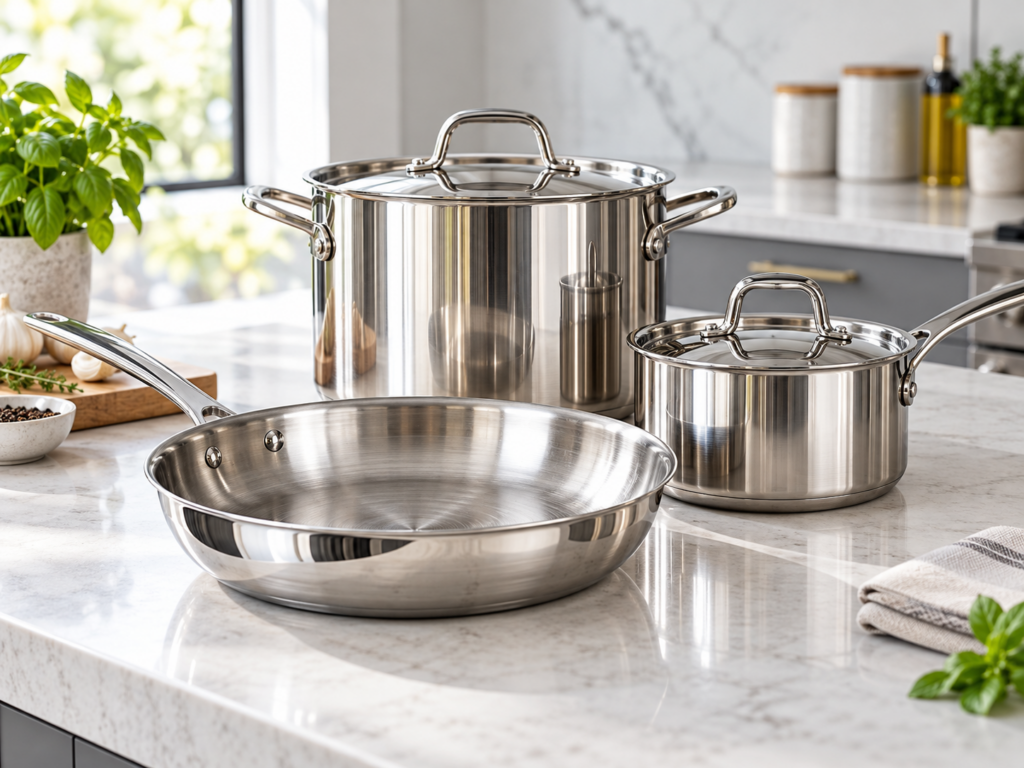
18/10 vs. 18/8 vs. 18/0 Stainless Steel Cookware: What Do the Numbers Mean?
If you have ever looked at the bottom of a stainless steel pan and wondered what numbers like 18/10, 18/8, or 18/0 mean, you are not alone.
They are not sizes or quality scores. The numbers refer to the approximate amounts of chromium and nickel used in the stainless steel.
Those ingredients affect characteristics such as corrosion resistance, appearance, and magnetism. But the numbers are only part of the story when choosing cookware.
What Do 18/10, 18/8, and 18/0 Mean?
The first number refers to the approximate percentage of chromium.
The second refers to the approximate percentage of nickel.
So, generally:
| Stainless Steel | Chromium | Nickel | What Home Cooks Should Know |
|---|---|---|---|
| 18/10 | About 18% | About 10% | Common in quality kitchenware and valued for corrosion resistance |
| 18/8 | About 18% | About 8% | Very similar to 18/10 and commonly used in kitchen products |
| 18/0 | About 18% | Little or no nickel | More magnetic and often useful for induction-compatible cookware |
These labels are useful, but they do not tell you everything about the pan.
What Does Chromium Do?
Chromium is an important part of what makes stainless steel resist corrosion.
It helps create a thin protective layer on the metal surface. That is one reason stainless steel is so useful in kitchens, where cookware regularly comes into contact with water, salt, food acids, and heat.
Stainless does not mean completely stain-proof, however. Improper cleaning, prolonged exposure to salt, or harsh chemicals can still affect the surface.
What Does Nickel Do?
Nickel helps improve corrosion resistance and contributes to the smooth, durable finish associated with many stainless steel kitchen products.
That is why 18/8 and 18/10 stainless steels are commonly found in cookware, flatware, mixing bowls, and other kitchen equipment.
But more nickel does not automatically mean a pan will cook better.
The way the entire pan is constructed matters too.
Is 18/10 Better Than 18/8?
For most home cooks, the difference between 18/10 and 18/8 is not something I would use as the sole reason to choose one pan over another.
Both can be good choices for kitchen use.
Instead, look at the whole piece of cookware:
- Is it fully clad?
- What material is inside the core?
- How heavy is the pan?
- Is the handle comfortable?
- Does it work with induction?
- How well does the manufacturer explain its construction?
- Is there a good warranty?
A well-designed 18/8 pan may be a much better purchase for you than a poorly designed pan simply labeled 18/10.
What About 18/0 Stainless Steel?
The zero means the steel contains little or no nickel.
One useful characteristic of many nickel-free stainless steels is that they are more magnetic.
That matters because induction cooktops require cookware with a magnetic-compatible base or exterior.
This is why a stainless steel pan may contain more than one type of stainless steel.
The cooking surface can be designed for durability and corrosion resistance, while the exterior layer helps make the pan compatible with induction.
Why Does Clad Construction Matter?
Stainless steel is durable, but it is not especially good at distributing heat by itself.
That is why many stainless steel cookware manufacturers bond stainless steel to a more heat-conductive material such as aluminum.
You may see terms such as:
3-ply: three bonded layers
5-ply: five bonded layers
The stainless steel provides the durable cooking and exterior surfaces, while the internal layers help spread heat more evenly.
That means the question is not simply:
“Is this pan 18/10?”
It is also:
“How is this pan constructed?”
Heritage Steel: One Example of Multiclad Stainless Steel Cookware
Heritage Steel is a family-owned cookware manufacturer in Clarksville, Tennessee, with more than 40 years of experience making specialty multiclad stainless steel cookware in the United States. The company also makes Hammer Stahl cutlery and other kitchen products. Awin _ LangleyGirl _ Advertiser…
That makes Heritage Steel a useful example of why cookware construction deserves as much attention as the numbers stamped on the steel.
Rather than looking only for an 18/10 label, consider how the stainless steel works together with the other layers in the pan.
Note: We are currently evaluating Heritage Steel for inclusion among CookwareTalk’s recommended cookware resources.
That last sentence lets us mention them naturally before affiliate approval without pretending there is already an affiliate relationship.
What Should You Look for When Buying Stainless Steel Cookware?
When comparing pans, I would look at several things together.
Stainless steel composition
18/8 and 18/10 are both widely used choices for kitchen products.
Construction
Look for information about whether the pan is fully clad, how many layers it has, and what materials are used in the core.
Induction compatibility
If you use an induction cooktop, verify that the cookware specifically says it is induction compatible.
Do not assume the interior stainless steel alone tells you that.
Weight
A heavy pan may feel substantial, but heavier is not automatically better if it becomes uncomfortable to lift once it is filled with food.
Choose cookware you can handle comfortably during everyday cooking.
Handles
Look for handles that feel secure and give you enough room to grip the pan comfortably.
Manufacturer transparency
A company that clearly explains its materials and construction makes it much easier to compare one pan with another.
Which Is Best: 18/10, 18/8, or 18/0?
There is no single answer for every part of a pan.
For a cooking surface, 18/8 and 18/10 stainless steels are both commonly used.
For an induction-compatible exterior, a more magnetic stainless steel may be useful.
That is why quality cookware often combines different materials instead of relying on one metal to do everything.
The Bottom Line
The numbers 18/10, 18/8, and 18/0 tell you something useful about the chromium and nickel content of stainless steel.
But they are not a complete cookware quality rating.
When choosing a stainless steel pan, pay attention to the entire construction: the cooking surface, internal layers, magnetic exterior, weight, handles, induction compatibility, warranty, and how clearly the manufacturer explains what you are buying.
Once you understand that, those little numbers on stainless steel cookware become much less mysterious.
Leave a Reply