Are Titanium Cutting Boards Bad for Knives? What Home Cooks Should Know
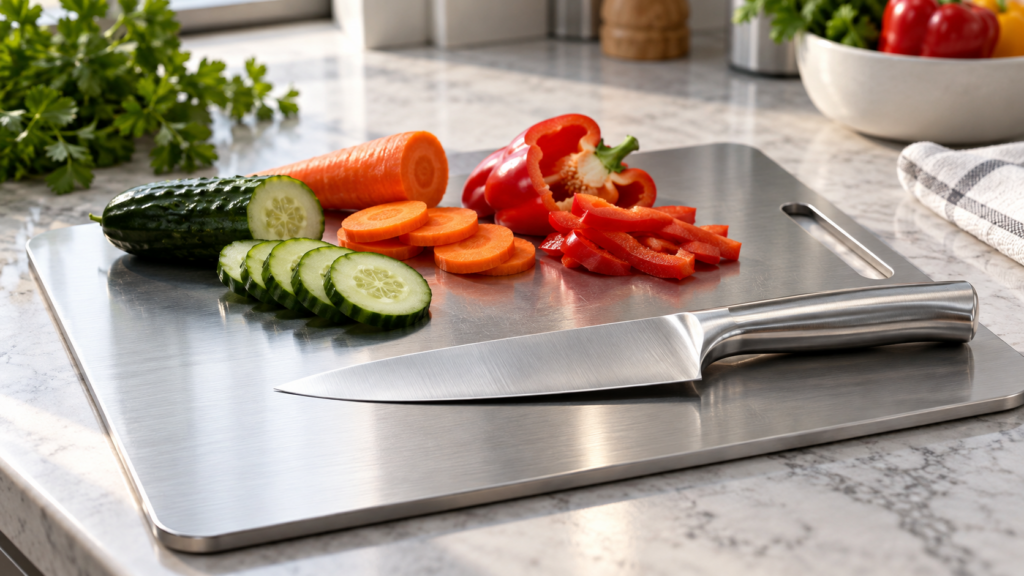
Are Titanium Cutting Boards Bad for Knives? What Home Cooks Should Know
Titanium cutting boards are getting attention from home cooks who want a durable, easy-to-clean alternative to wood and plastic. But before switching to a metal cutting surface, there’s an important question to ask:
Are titanium cutting boards bad for knives?
The short answer is: they can cause a knife edge to wear faster than a softer cutting surface such as wood or some plastics. That doesn’t mean a titanium cutting board will immediately ruin your knives. How quickly a blade dulls depends on the board’s construction, your knife, how often you cook, and the way you cut.
Here’s what home cooks should know before deciding whether titanium belongs in the kitchen.
Why Cutting Board Material Matters
Every time you slice, chop, or mince, the edge of your knife eventually makes contact with the cutting board.
Softer cutting surfaces have a little more give when the blade reaches them. Harder, more rigid surfaces give less, which means more of the impact is absorbed by the knife edge.
That is one reason many cooks prefer wood when protecting sharp knives is a priority.
Titanium is a rigid metal surface, so it does not provide the same cushioning effect as a traditional wooden cutting board.
Will a Titanium Cutting Board Ruin Your Knives?
Not necessarily.
There is an important difference between gradual edge wear and actually damaging a knife.
Using a titanium board does not mean your chef’s knife will suddenly become unusable after preparing dinner. However, if you do a lot of heavy chopping, you may find that your knives need honing or sharpening more often than they would when used on a softer surface.
Your cutting style matters too.
A smooth slicing or rocking motion is generally easier on a knife edge than repeatedly striking the board with a forceful chopping motion.
Titanium vs. Wood for Knife Care
If keeping your knives sharp for as long as possible is your top concern, wood remains one of the most knife-friendly choices.
Wood has some natural give, particularly compared with very rigid materials.
Titanium, on the other hand, may appeal to cooks for different reasons. Depending on the particular board, advantages may include:
- A nonporous surface
- Resistance to absorbing odors
- Easy cleanup
- Resistance to staining
- Durability
- An alternative for cooks trying to reduce their use of plastic cutting boards
That makes the decision less about finding one “perfect” cutting board and more about deciding which features matter most in your kitchen.
Is Titanium as Hard on Knives as Glass or Stone?
Glass, ceramic, marble, and stone cutting surfaces are generally poor choices for protecting knife edges because they are extremely rigid and unforgiving.
Titanium should not automatically be treated as identical to glass or stone. Titanium grades and board construction can vary considerably.
That is also why it is worth checking exactly what a manufacturer means by “titanium cutting board.” Some products may be solid titanium, while others may use titanium as part of a layered or coated construction.
If protecting a finely sharpened knife is your number-one concern, a quality wooden board remains the safer choice.
Can You Use Both Wood and Titanium?
Absolutely.
You do not have to choose one cutting board for every kitchen task.
A wooden board can be used for jobs involving lots of chopping and slicing, while a titanium board can be reserved for food-prep jobs where its nonporous, easy-care surface is especially convenient.
Using different boards for different jobs may give you the advantages of both materials.
How to Reduce Knife Wear on a Titanium Cutting Board
If you decide a titanium board fits your kitchen, a few habits may help protect your knives.
Use a smooth slicing or rocking motion instead of striking the board unnecessarily hard.
Keep your knives properly honed and sharpened rather than waiting until they become extremely dull.
Use the right knife for the job, especially when doing heavier chopping.
And pay attention to how your particular knives respond. If you notice that one of your favorite knives is losing its edge much faster, consider using a softer cutting board for that knife.
Are Titanium Cutting Boards Worth It?
That depends on what matters most to you.
If your first priority is maintaining a finely sharpened knife edge, wood is difficult to beat.
If you place more value on having a durable, nonporous, low-maintenance cutting surface, a titanium board may still deserve a place in your kitchen—as long as you understand that your knives may need a little more maintenance.
Titanium cutting boards are not automatically “bad” for knives, but they do come with a tradeoff.
The best cutting board is the one that fits how you actually cook, clean, and care for your kitchen tools.
Want to Compare Your Options?
Still deciding?
Read our guide to Wood vs. Stainless Steel vs. Titanium Cutting Boards: Which Fits Your Kitchen? to compare the materials side by side.
And if you’ve decided that titanium fits the way you cook, you can [see the titanium cutting board we recommend here].
Disclosure: CookwareTalk may earn a commission from qualifying purchases made through affiliate links, at no additional cost to you.
Leave a Reply