Lightweight Cookware for Older Adults: What to Look for When Heavy Pans Are Hard to Handle
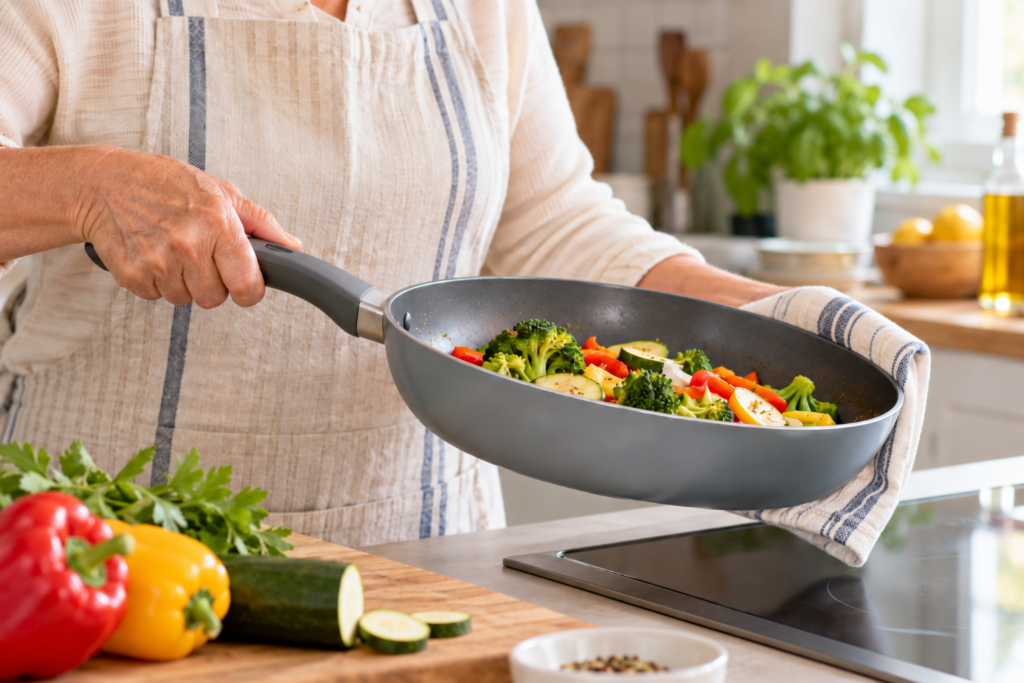
Lightweight Cookware for Older Adults: What to Look for When Heavy Pans Are Hard to Handle
A beautiful pan isn’t very useful if you dread picking it up.
As we get older, cookware weight can start to matter more than it once did. A large skillet that felt perfectly manageable years ago may become awkward when it is filled with food. Heavy lids, thick handles, and oversized stockpots can also make everyday cooking more work than it needs to be.
That doesn’t mean you have to give up good cookware.
The goal is simply to choose pots and pans that are comfortable to lift, easy to control, and practical for the way you cook now.
Here are some of the most important things to consider when shopping for lightweight cookware.
Start With the Weight of the Empty Pan
When cookware shopping, it is easy to focus on size, material, coating, or appearance and forget one very practical question:
How heavy is this pan before I put anything in it?
Remember that the listed weight is only the starting point.
Add water, vegetables, pasta, meat, or sauce, and a manageable pan can quickly become much heavier.
If a skillet already feels cumbersome while empty, it probably won’t become more comfortable once dinner is inside it.
Whenever possible, check the manufacturer’s listed product weight before buying.
If you are shopping in person, pick the pan up and hold it for a few seconds. Pretend you are moving it from the stove to the counter.
That simple test can tell you more than the packaging.
Bigger Is Not Always Better
A large 12- or 14-inch skillet may sound convenient, but bigger cookware usually means more weight.
For one- or two-person households, a smaller pan may handle most everyday cooking jobs while being considerably easier to maneuver.
Instead of buying the biggest cookware available, think about what you actually prepare most often.
A smaller skillet, saucepan, or Dutch oven may be easier to:
- Lift from the stove
- Carry to the sink
- Drain
- Wash
- Store
- Control while stirring or tossing food
Sometimes downsizing the cookware makes cooking easier without really reducing what you can prepare.
Pay Attention to the Handles
Pan weight is only part of the story.
A well-designed handle can make a heavier pan feel easier to control, while an uncomfortable handle can make even a relatively light pan frustrating.
Look for handles that feel secure and provide enough room for a comfortable grip.
For larger pans and pots, a helper handle on the opposite side can be especially useful. Instead of putting the entire load on one wrist, you can lift with both hands.
That can make transferring a full skillet or pot much more manageable.
Don’t Forget the Lid
Lids can be surprisingly heavy.
A sturdy glass lid may be convenient because you can see the food while it cooks, but large glass lids can add noticeable weight.
If cookware weight is important to you, consider the pan with its lid, not just the base.
Ask yourself whether you can comfortably:
- Lift the lid with one hand
- Hold it while stirring
- Move the covered pot
- Wash and store it safely
A lightweight pot with an extremely heavy lid may not solve the problem you were trying to fix.
Which Cookware Materials Tend to Be Lighter?
Cookware weight varies considerably by construction, thickness, and size, so the material alone does not tell the entire story.
Still, there are some general differences worth knowing.
Aluminum
Aluminum cookware is often relatively lightweight and heats quickly.
Some aluminum cookware is anodized or combined with coatings or other materials to improve durability and cooking performance.
If easy lifting is a priority, aluminum-based cookware is worth comparing.
Stainless Steel
Stainless steel cookware can range from reasonably manageable to quite heavy.
Many quality stainless pans contain multiple layers of metal. That construction can improve cooking performance, but additional layers also add weight.
Check the weight of the individual pan rather than assuming all stainless cookware will feel the same.
Cast Iron
Traditional cast iron is extremely durable and holds heat very well, but weight is one of its biggest drawbacks for cooks who want easy-to-handle cookware.
A large cast-iron skillet can become particularly challenging once it is full.
If you love cast iron but struggle with the weight, consider keeping a smaller piece for certain dishes rather than relying on it for every meal.
Carbon Steel
Carbon steel is often lighter than comparable cast iron, although larger pieces can still feel substantial.
It may appeal to cooks who like some of the characteristics of cast iron but want something a little easier to maneuver.
Titanium
Titanium is known for being strong without requiring a lot of weight, but cookware labeled “titanium” can be constructed in very different ways.
Some products use titanium as part of a coating or layered construction rather than being made entirely from titanium.
So if lightweight cookware is your goal, check the actual product weight and construction, not simply the word “titanium” on the label.
Think About What Happens After Cooking
Sometimes we judge cookware only by what happens on the stove.
But after dinner, that pan still has to be carried, emptied, washed, dried, and put away.
That is where lighter cookware can make a noticeable difference.
A pan that is comfortable throughout the entire process may be more useful than a heavier pan with features you rarely need.
Consider your kitchen setup too.
If your pans are stored in a low cabinet or high shelf, weight may matter even more because you have to lift them from an awkward position.
Easy Cleaning Matters Too
Lightweight cookware isn’t much help if it takes extensive scrubbing afterward.
For many older cooks, the ideal pan is one that combines:
manageable weight + comfortable handles + easy cleanup + dependable cooking performance.
That combination may matter more in everyday life than owning the thickest or most expensive cookware available.
Consider Buying Individual Pieces
You don’t necessarily need an entire matching cookware set.
In fact, buying individual pieces can be a smarter approach if weight is one of your main concerns.
You might choose:
- One lightweight everyday skillet
- One smaller saucepan
- One medium pot with two handles
- One larger piece for occasional cooking
That allows you to build a kitchen around the pieces you can comfortably use instead of ending up with several heavy pots sitting unused in a cabinet.
Try the “Full Pan” Test
Here’s a simple shopping test.
When considering a pan, don’t ask only:
“Can I lift this?”
Ask:
“Could I comfortably lift this if it contained dinner?”
Imagine that skillet holding several portions of food or that saucepan filled with water.
That is the weight that matters.
Good Cookware Should Work for You
Cookware doesn’t earn extra points for being difficult to lift.
As our needs change, our kitchens can change with us.
Choosing lighter cookware, smaller sizes, better handles, or easier-to-clean materials isn’t giving anything up. It is simply choosing equipment that makes cooking more comfortable.
Whether you’re cooking for yourself, a partner, grandchildren, or a house full of family, the best cookware is cookware you can use confidently and comfortably.
So before your next cookware purchase, look beyond the brand name and the shiny finish.
Pick it up.
Check the handle.
Notice the lid.
Look at the weight.
And ask the most practical question of all:
Will I enjoy using this pan once it’s full of food?
That answer may tell you more than any product label ever could.
Leave a Reply