stainless steel cookware
Why Does Food Stick to Stainless Steel? The Heat Mistake Most Home Cooks Make
Affiliate disclosure: CookwareTalk may earn a commission from some links on this site at no additional cost to you. Affiliate relationships do not determine our editorial conclusions.
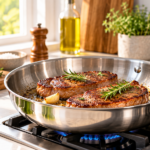
You bought a shiny stainless-steel pan. You heated it up, dropped in a piece of chicken, and five seconds later the chicken appeared to have signed a lifetime lease with the skillet.
That does not automatically mean the pan is bad.
Stainless steel simply behaves differently from a coated nonstick pan. It rewards a little temperature control, enough cooking fat, dry food, and—this is the part many of us hate—patience.
The short answer: sticking usually starts before the food hits the pan
Two major stainless-steel cookware makers, All-Clad and Made In, give very similar advice: preheat the pan over low-to-medium or medium heat, add oil after the pan is hot, let the oil heat, then add food. They also recommend drying food before cooking and waiting until proteins naturally release before trying to turn them.
In plain CookwareTalk language: pan first, oil second, food third.
Mistake #1: starting with a cold pan
If food goes into stainless steel before the pan is properly preheated, it is more likely to grab the surface. Give the pan a little time to warm evenly instead of racing straight from burner-on to food-in.
All-Clad recommends low to moderate heat for preheating. Made In commonly suggests medium heat for a few minutes. Your exact burner and pan will differ, so think of those as starting points rather than stopwatch rules.
The water-drop clue
One common readiness check is a few drops of water. On a properly heated stainless surface, the drops can bead and move across the pan instead of immediately disappearing. You do not need to turn this into a chemistry experiment. It is simply a visual clue that the pan has warmed up.
Important: do the water check before adding oil. Do not toss water into a pan that already contains hot oil.
Mistake #2: using too little fat—or adding food before the fat is hot
Once the pan is preheated, add enough oil or other cooking fat to lightly coat the area where the food will sit. Give that fat a moment to warm. Oil that shimmers is a useful visual cue; oil that is aggressively smoking means the pan may be hotter than you need.
Stainless steel is not trying to imitate a brand-new coated skillet with no added fat. A modest amount of cooking fat is part of the technique.
Mistake #3: putting wet food into the pan
Moisture fights browning. Pat the surface of meat, fish, tofu, or other foods dry when the recipe allows. That helps the food make better contact with the pan and reduces splattering.
For frozen or refrigerator-cold proteins, follow your recipe and food-safety needs, but know that a very cold, damp surface can make clean searing harder.
Mistake #4: trying to flip too soon
This may be the hardest stainless-steel lesson: stop poking the food.
When a protein is browning properly, it can cling at first and then release more easily as the cooked surface develops. If your spatula meets serious resistance, give the food another moment instead of scraping it loose immediately.
All-Clad specifically notes that food on stainless steel is ready to turn when it no longer sticks strongly to the pan.
Mistake #5: overcrowding the skillet
A pan full of cold food can lose heat quickly. Crowding also traps steam. Instead of browning, the food can sit in released moisture and cook unevenly.
If you are chasing a good sear, leave breathing room. Two batches are often faster than one overloaded batch that never browns the way you wanted.
What about eggs?
Eggs are a higher-skill stainless-steel test because they are delicate and protein-rich. They usually need closer control of heat and enough butter or oil. If eggs are your main breakfast and you do not enjoy managing pan temperature, it is completely reasonable to use a different pan for that job.
CookwareTalk is not here to declare that one material must perform every kitchen task.
The 5-step stainless-steel reset
Preheat gently. Start around low-to-medium or medium heat, depending on your pan and burner.
Dry the food. Remove excess surface moisture when appropriate.
Add the fat after preheating. Let it warm until it looks fluid and shimmery.
Add food and listen. A steady sizzle is better than silence or an explosive crackle.
Wait for release. Let browning do its job before forcing the flip.
When sticking is actually useful
Those browned bits left in the pan after searing are called fond, and they can be the beginning of a very good pan sauce. After the food comes out, liquid such as stock can loosen the browned bits while the pan is still warm. That is one of the reasons cooks love stainless steel in the first place.
CookwareTalk bottom line
If everything sticks to your stainless-steel pan, do not replace the pan first. Change the sequence first.
Preheat. Add fat. Add dry food. Then give it time.
If that solves the problem, congratulations: the pan was not broken. It was just waiting for the two of you to learn each other’s language.
Keep reading on CookwareTalk
If you want to see why pan material matters with acidic foods, read I’m a Tomato. Why Are You Cooking Me in THAT Pan? 🍅
Sources & Learn More
I’m a Tomato. Why Are You Cooking Me in THAT Pan? 🍅
Meet Tammy the Tomato
Excuse me.
Yes, you.
Before you dump me into that pan, I have a question.
Do you know what I’m actually touching?
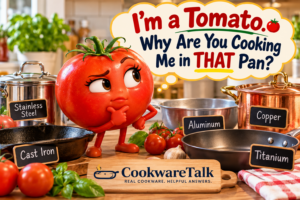
I’m Tammy the Tomato. I’m juicy, delicious and just acidic enough to make your choice of cookware worth thinking about.
I’m not trying to make dinner complicated.
I’m trying to keep you from grabbing a pan simply because it happens to be clean.
Different cookware materials behave differently depending on the food, the condition of the cookware and how it is used. Health Canada notes that all three of those factors can affect how substances from cookware transfer into food.
So before we make that spaghetti sauce, let’s take a quick tour of the cookware cabinet.
Stainless Steel: “Okay, We Can Work Together.”
Stainless steel is strong, long-lasting and resistant to rust and staining.
It is generally made from iron combined with other metals, including chromium. That chromium helps form the thin protective surface layer that gives stainless steel its corrosion resistance.
For a home cook making tomato sauce, soup or chili, stainless steel is a practical material to understand because it does not rely on an applied nonstick coating to form its cooking surface.
There is a catch, though.
Stainless steel wants you to learn your heat.
Food sticking to stainless steel can have as much to do with cooking technique as the pan itself. Preheating, burner temperature and when food goes into the pan all matter.
And that is a conversation Stella Stainless is going to insist we have very soon.
Tammy says:
“I’m willing to simmer. I’m not volunteering to be scorched to the bottom of your pot.”
Cast Iron: “I Like You. But Maybe Not for an All-Day Date.”
Cast iron is durable, versatile and excellent at holding heat.
But Tammy and an uncoated cast-iron pan may need some boundaries.
Health Canada specifically recommends avoiding cooking or storing acidic foods such as stewed tomatoes in uncoated cast iron for long periods.
That does not mean one tomato touching a cast-iron skillet causes a kitchen emergency.
The important words are acidic food and long periods.
A quick recipe containing tomatoes is different from simmering tomato sauce for several hours.
So for the long relationship?
Tammy may want another pan.
Tammy says:
“You’re wonderful, Cast Iron. I just don’t think we should spend the whole afternoon together.”
Aluminum: “Wait. What Kind of Aluminum Are We Talking About?”
Aluminum is a popular cookware material for good reasons.
It is lightweight, relatively inexpensive and conducts heat well.
But acidic foods deserve more attention when ordinary aluminum is the food-contact surface.
Health Canada says foods high in acid or salt — including tomatoes, citrus products and sauerkraut — can increase the transfer of material from aluminum cookware into food. It recommends avoiding cooking or storing highly acidic foods in ordinary aluminum cookware for long periods.
But here is where understanding cookware construction matters.
Anodized aluminum is different.
Anodizing creates a harder surface and reduces the transfer of aluminum from cookware into food, particularly acidic foods such as tomatoes.
So simply asking:
“Is this an aluminum pan?”
may not tell you enough.
CookwareTalk would rather ask:
What is the actual cooking surface?
That is one of the most useful questions you can learn to ask about any piece of cookware.
Tammy says:
“Read the pan, people. I cannot do everything around here.”
Copper: “Please Keep Your Jacket On.”
Copper cookware is valued because copper conducts heat extremely well.
But bare copper is reactive.
That is why copper cookware intended for cooking is commonly lined with another material that separates the copper from the food. Health Canada advises against using scratched or uncoated copper cookware for cooking or storing food and recommends replacing a damaged inner coating.
There is also a useful regulatory example from the U.S. FDA Food Code. In commercial food-service settings, copper and copper alloys generally may not contact foods with a pH below 6, such as vinegar, fruit juice and wine.
So if Tammy sees a beautiful copper pot, she isn’t asking whether the outside looks impressive.
She wants to know:
What is lining the inside?
Tammy says:
“Nice copper. Very pretty. Now show me the part I’m actually cooking on.”
Titanium: “Okay… But What Does ‘Titanium’ Mean Here?”
Here is where cookware shopping can get confusing.
The word titanium on a product does not necessarily mean the entire pan is made from one solid piece of titanium.
Cookware may combine several materials, with each layer serving a different purpose.
So when a pan is marketed with titanium, CookwareTalk would still ask the same question:
What is the actual cooking surface, and how does the manufacturer describe the pan’s construction?
That is part of learning to read cookware instead of relying on one big word on the package.
Want Stainless Steel to Behave Better?
Tammy already warned us that stainless steel wants you to learn your heat. If you have ever wondered why eggs, fish, or other foods suddenly seem glued to a stainless-steel pan, continue with our next guide:
🍳 Read Next: Why Does Food Stick to Stainless Steel? The Heat Mistake Most Home Cooks Make
So What Pan Should Tammy Choose?
Here is the bigger lesson.
You do not need to memorize an enormous chart of cookware materials before making dinner.
Start with three questions:
- What surface is actually touching my food?
- What kind of food am I cooking?
- Am I using and caring for this cookware the way the manufacturer intended?
Those questions give you a much more useful framework than simply deciding a material is always “good” or always “bad.”
That is exactly what CookwareTalk is here to help you figure out.
Tammy’s Final Word 🍅
See?
I wasn’t being difficult.
I was being educational.
The next time you open a can of crushed tomatoes, squeeze a lemon or add a splash of vinegar, take a second before reaching for the nearest pan.
Look at the cooking surface.
Think about the food.
Then cook.
And if you happen to make spaghetti sauce after reading this?
Tammy would like credit.
Now please put me in the sauce. I’ve been waiting through this entire article.