Uncategorized
How to Care for Cutting Boards: Wood, Plastic, Stainless Steel & Titanium
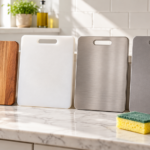
A cutting board may seem like one of the simplest tools in your kitchen, but different materials need different kinds of care.
The cleaning routine that works perfectly well for a plastic board may shorten the life of a wooden one. Stainless steel and titanium are generally easy-care surfaces, but they still benefit from proper washing and drying.
The good news? None of this has to be complicated.
Here’s how to care for some of the most common cutting board materials—and a few things you’ll want to avoid.
Are Titanium Cutting Boards Bad for Knives? What Home Cooks Should Know
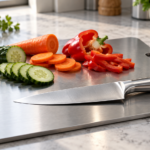
Titanium cutting boards are getting attention from home cooks who want a durable, easy-to-clean alternative to wood and plastic. But before switching to a metal cutting surface, there’s an important question to ask:
Are titanium cutting boards bad for knives?
The short answer is: they can cause a knife edge to wear faster than a softer cutting surface such as wood or some plastics. That doesn’t mean a titanium cutting board will immediately ruin your knives. How quickly a blade dulls depends on the board’s construction, your knife, how often you cook, and the way you cut.
Here’s what home cooks should know before deciding whether titanium belongs in the kitchen.
Best Induction Cookware for Even Heat (2026)
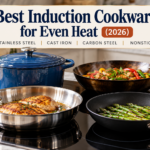
The best induction cookware starts with a flat, magnetic base that matches the size of your cooktop’s cooking zone. Construction matters too: a well-made pan with a substantial base can help spread heat more evenly and respond predictably to changes in power.
There is no single cookware material that is best for every job. Fully clad stainless steel is a strong all-purpose choice, enameled cast iron excels at heat retention, carbon steel works well for high-heat cooking, and induction-compatible nonstick can be useful for delicate foods.
Before You Buy That Stainless Steel Pan: What 18/10, 18/8 and 18/0 Really Mean
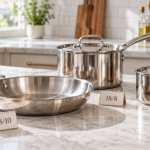
You’re comparing two shiny stainless-steel pans.
One says 18/10 stainless steel.
Another says 18/8.
Then you find a third marked 18/0.
So naturally, 18/10 must be the best one, right?
Not necessarily.
And here’s the first surprise: those numbers do not tell you how thick, heavy or heavy-duty the pan is.
They describe the approximate makeup of the stainless-steel alloy—specifically its chromium and nickel content. British Stainless Steel Association
Once you understand that, stainless-steel labels start making a lot more sense.
How to Care for Wood, Stainless Steel, and Titanium Cutting Boards
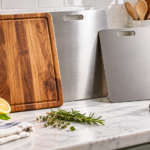
Choosing a cutting board is only half the story.
Once you find a board that fits the way you cook, the next question is pretty simple:
How do I take care of this thing?
Wood, stainless steel, and titanium cutting boards can all give you a useful prep surface, but they don’t necessarily want to be cleaned and maintained the same way.
The good news? Cutting-board care doesn’t have to become another kitchen project.
Here’s what to know.
Grill, Portable Stove, or Camp Cooker? Choosing an Outdoor Cooking Setup

Affiliate disclosure: CookwareTalk may earn a commission if you purchase through some links in this article, at no additional cost to you. Affiliate relationships do not determine our editorial conclusions.
You can cook outdoors with a $40 single-burner stove, a two-burner camp kitchen, a high-heat grill, a pizza oven, or a compact backpacking cook system.
That is the good news.
The bad news is that shopping gets confusing fast if you start with products instead of meals.
So before you ask, “Which cooker should I buy?” ask a better question:
What do I actually want to cook, for how many people, and how far do I have to carry the equipment?
Kitchen Germs: What Actually Needs Cleaning—and What Are We Overthinking?
CookwareTalk note: This article is general food-safety information, not medical advice. People at higher risk for serious foodborne illness should follow guidance from their healthcare professional and public-health authorities.
Some kitchen habits deserve our attention.
Others mostly deserve to stop living rent-free in our heads.
You do not need to turn dinner cleanup into a surgical scrub. You do need to pay attention to the places where raw-food juices, dirty hands, utensils, and ready-to-eat foods can cross paths.
The simplest framework comes from CDC: Clean. Separate. Cook. Chill.
Wood vs. Stainless Steel vs. Titanium Cutting Boards: Which Fits Your Kitchen?
Affiliate disclosure: CookwareTalk may earn a commission if you purchase through some links in this article, at no additional cost to you. Recommendations and tradeoffs are based on product fit and available evidence, not on which offer pays a commission.
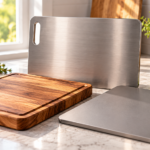
Three cutting boards can all be washable, durable, and useful—and still feel completely different in your kitchen.
Wood gives you a softer, classic cutting surface. Stainless steel gives you a hard, nonporous work surface with very little routine care. Titanium aims for a similar low-maintenance metal experience with less weight than many steel boards.
So which one is “best”?
That depends on what you care about enough to notice every single day.
Why Food Sticks to Stainless Steel Pans (and How to Prevent It)

Affiliate disclosure: CookwareTalk may earn a commission from some links on this site at no additional cost to you. Affiliate relationships do not determine our editorial conclusions.
You bought a shiny stainless-steel pan. You heated it up, dropped in a piece of chicken, and five seconds later the chicken appeared to have signed a lifetime lease with the skillet.
That does not automatically mean the pan is bad.
Explore 360 Cookware Stainless Steel Pans (paid link)
I’m a Tomato. Why Are You Cooking Me in THAT Pan? 🍅

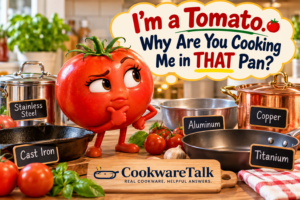
Meet Tammy the Tomato
Excuse me.
Yes, you.
Before you dump me into that pan, I have a question.
Do you know what I’m actually touching?